Sunday, March 17, 2013

Rolling on the River --- Delta Style (Day 5 BA)


On Sunday we took a trip away from the heart of Buenos Aires where waterways replace roads. El Tigre (and the Parana Delta) has hundreds of canals and tributaries. The water is the color of murky and muddy chocolate with a bit of rust thrown in for good measure. I felt like I was truly in another country now with how exotic the river views were: plush resorts on one side and rusted-out hulls of huge ships on the other. Plants one would find on the set of Jurassic Park on one side and straw umbrellas that looked like fancy acorn caps in a line on the other.
It was recommended we to go to El Gato Blanco (The White Cat) for lunch once our boat stopped.
We ate lunch outdoors on an umbrella-filled patio. For you, Carol, take a look at the food! I would like to say here that, in Argentina, beef reigns supreme.  Pasta is a very popular option, too, thanks to Italians coming in droves in the early 1900s.


After our wonderful three-hour lunch we again boarded the boat. Do note one of the most unusual sights - a house completely housed in plates of glass...???


 Once on the homeward-bound train we saw this guy drinking a mate (may-tay)
which is a strong tea made from the dried leaves of a yerba plant and served from a hollowed out gourd.  A metal straw with a filter on the bottom prevents the leaves from being sucked up.
Meanwhile the couple directly behind him just  about consumed each other up, too!


Thursday, March 14, 2013

Care to Dance? (Day 4 BA)

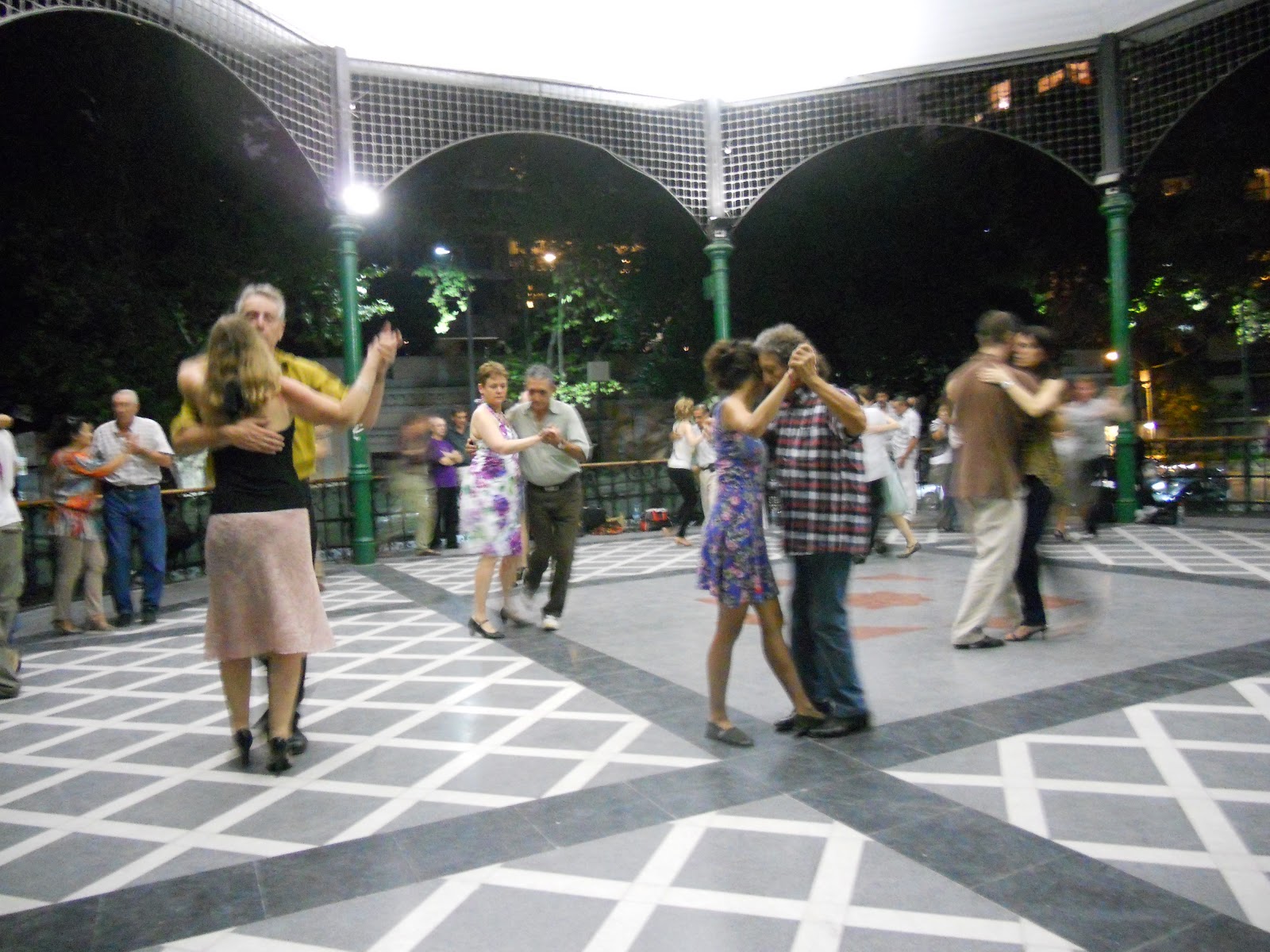
The end of Day #3 found us in a park after dark where tango occurs nearly every night between 7:00 and 10:00 PM. This park gazebo is quite large and fully equipped with an excellent speaker system hooked up to play various CDs.
Enough of watching...we had to attempt the tango, too!
At this point it would be good to tell you a little bit of history about the dance that originated in Argentina. In the 1770s African slaves were brought to Argentina and this population grew until 30% of the people living in Buenos Aires were African.  By 1853 slavery was abolished. When freed slaves would meet together to dance and socialize these meetings were called tango.

   Meeting to dance? Bring on the passion and sizzle!
Bring on the African drum rhythms and add in the accordion called the bandeon!
Bring on the critics from high society. They considered the tango to  be vulgar and distasteful.
 
Enter travel to Paris by the sons of Buenos Aires aristocrats and spreading the word about the
sensuous tango dance.  From Paris to London and to North America the popularity of the tango grew.
By 1913, the tango was considered the  dance of the year.
 
And here in Buenos Aires, Argentina in 2013 we witnessed the tango firsthand in the land of its birth.
In a gazebo, in a park. Belgrano Plaza park.
 
 separated ; 


Around and around the couples danced. You could hear their feet swish on the surface of the floor. The uneven hems on many of the female dancers dresses flared out as they dipped and kicked. It was
artwork in motion.
Now for your viewing pleasure a little video clip!
(Oh, how I hope it works; there have been issues.)

Tuesday, March 12, 2013

Dying to be Here (Day 4 BA)


Never before have we seen a cemetery like this...it is both creepy and beautiful at the same time.
Welcome to the Cemeterio De La Recoleta - The Recoleta Cemetery.
Think of this as a cemetery neighborhood with miniature-sized (though still quite grand) mansions, Greek temples, pyramids and stone structures. Look through the grill work on the mausoleum doors and see the actual coffins.  Some have stained glass windows and mantels that hold holy water, candelabras and crosses.  Since 1822 some of Arentina's most famous people have been buried here...a dictator, war heroes and obviously the top society members based upon the expense it took to erect these monuments of memory.

Towards the back of the 13.5 acre, 6,400 "residents" you will find the most visited gravesite of all.

The embalmed remains of Evita (whereabouts unknown for about 17 years and finally resting in the Duarte family tomb) seem to draw the biggest crowd of visitors.  We actually had to wait in a silent line as many paid their respects to her posthumously.

Leaving the cemetery you again pass through the gateway and the see the words
 written over the doorway translates to Lord Waiteth.

It is rather bizarre to think of this walled city of vaulted tombs and elaborate mausoleums.  I have never seen quite like it before.
Rest in peace, all.


Monday, March 11, 2013

On Stage (more BA Day 3)


Following our big morning at The Food Bank, we hopped on the subway once again to explore more in the city of Buenos Aires. This time we had culture in mind. Theatre culture. One theatre visit was led by a tour guide and the other was a freebie. Both were impressive! And now, ladies and gentlemen, presenting...
 
STAGE # 1 Teatro Colon.  The Opera House.
 
Teatro Colon took 18 years to build and was inaugurated in 1908 with Verdi's Aida. Sumptuous building materials - three kinds of Italian marble, stained glass from France and Venetian mosaics - were imported from Europe
to create large-scale lavishness.  (That last sentence isn't mine; it comes directly from FODOR'S Buenos Aires travel guidebook.  I liked it so much I had to use it.)
 
Also, I happily report that, contrary to the guidebook, the Opera House is now up and running again after a lengthy renovation project.
 
This place is gorgeous!
 
The last part of our tour included taking a seat inside the Opera House. Looking forward we saw the stage, looking sideways we saw the box seats and looking up revealed the most impressive view of the painted dome and chandelier. This chandelier drops down and there is seating up there for musicians to add "special effects" to the performances.
_ _ _ _ _ _ _ _ _ _ _ _ _ _ _ _ _ _ _ _ _ _ _ _ _ _ _ _ _ _ _ _ _ _ _ _ _ _ _ _ _ _

STAGE #2 - several blocks away from The Opera House.  Same afternoon.
 
Imagine this: a theatre has staged its final performance.
 A beauty of a building with no one inside to clap, ooh and ahh. Opened in 1919
as Teatro Gran Splendid, the theatre seating could handle up to 1,050 patrons.
Many tango performances, radio broadcasts and other productions later, it was decided in
1929 to use the theatre for movies.
Fast forward to a wrecking ball about ready to swing and destroy the theatre in the late 90s.
Someone had the idea to invest in this gem, renovate and convert it to a book and music store
and in February of 2000, the work was begun.

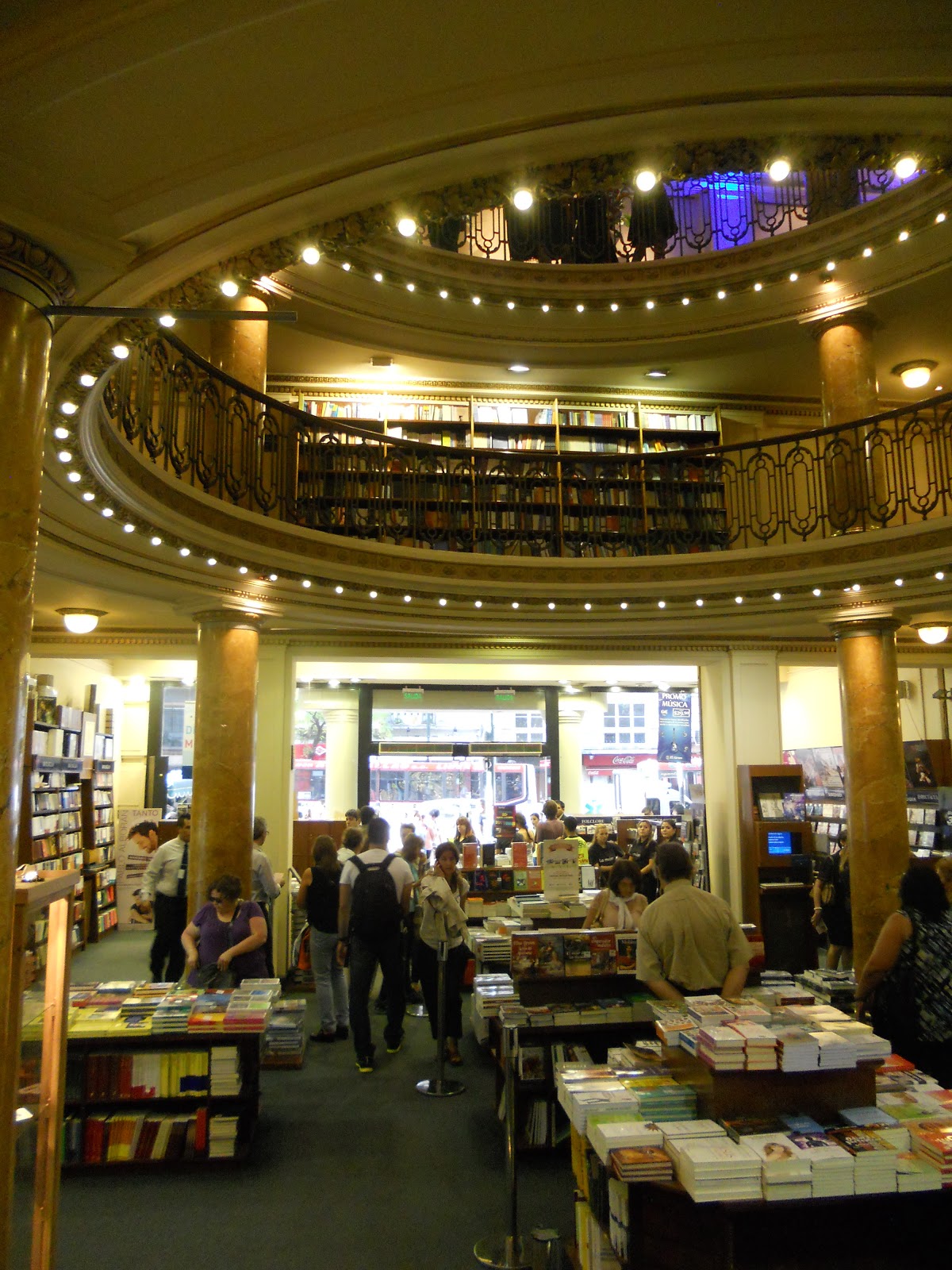
The theatre is now known as Libreria El Atenco.
Original balconies, painted dome ceiling, ornate carvings and the stage has
 been saved. What was once the stage is a cafe-type restaurant.  An opening was made in
 the auditorium floor with a stairway to the lower level constructed - now home to the
children's collection and music CDs.
 

Note that the theatre houses books in the box seat area and lobby.


Imagine my thrill finding Miss Olivia on the shelves in the Children's area!
Once you have made you purchase(s), simply go to the ticket booths to pay.
 
Our purchases included two items: a board book (in Spanish) for Miss M
and a Memo Corazon memory card game for Miss E.
 
If I would've had more time and pesos, I could have done some serious damage here!

Which theatre do you like best?